
The short version
If you read nothing else on this page, read this table.
| What it is | Structuring content so AI systems retrieve it, trust it, and cite it inside a generated answer. |
|---|---|
| What it is not | A replacement for SEO, a file you upload, or a special writing style that machines secretly prefer. |
| Where the term came from | A 2024 ACM SIGKDD paper by Aggarwal et al., tested across a 10,000 query benchmark. |
| Best measured tactic | Adding relevant quotations from credible sources. Visibility went from 19.5% to 27.8%, about a 43% relative gain. |
| Only tactic that backfired | Keyword stuffing. Visibility fell from 19.5% to 17.8%. |
| Who benefits most | Pages that already rank, but outside the top few positions. The gains were largest at rank 4 and 5 and negative at rank 1. |
| How you measure it | Citation and mention share inside AI answers, not keyword position. Rank tracking alone will not show it. |
Sources are cited in full in the relevant sections below.
The plain definition
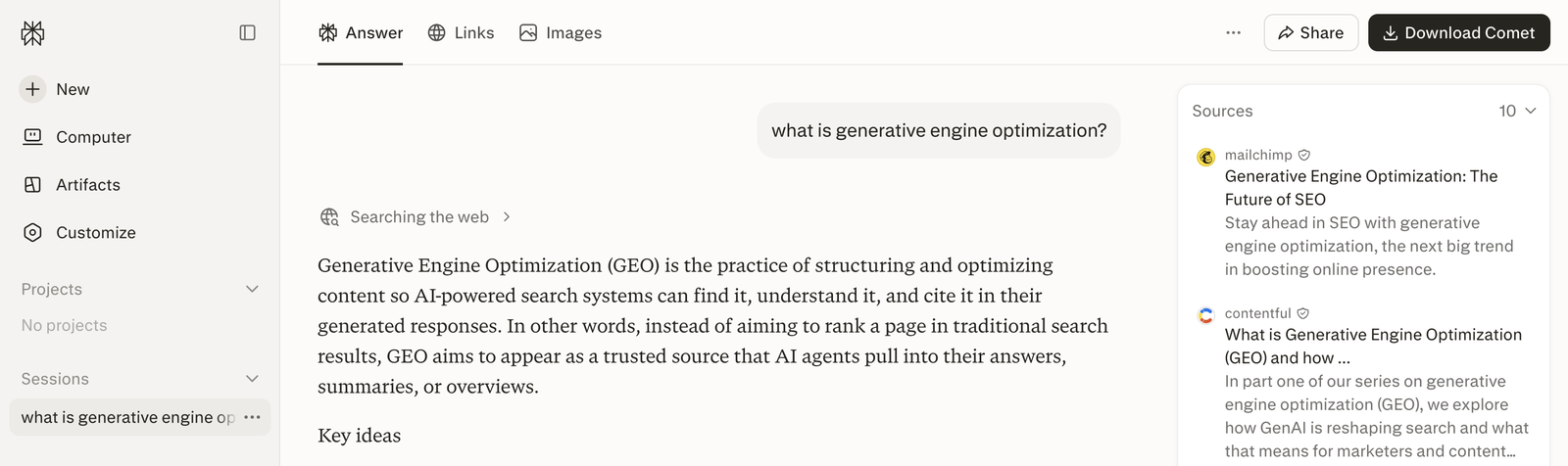
Generative engine optimization (GEO) is the practice of structuring content so AI systems, ChatGPT, Perplexity, Google AI Overviews, Gemini, retrieve it, trust it, and cite it in the answers they generate, rather than citing a competitor. It sits next to SEO rather than replacing it. SEO gets you into the pool of pages a system considers. GEO affects whether you get pulled out of that pool and named in the actual answer.
That second step is the part classic SEO was never built to measure. A page can rank well and still lose the citation decision entirely, which is the whole reason this term exists.
GEO, AEO, LLMO and the rest of the alphabet
Five or six acronyms are circulating for roughly one idea, and the overlap is genuinely confusing rather than just annoying. Here is what each one usually means when someone uses it.
Swipe the table sideways to see every column.
| Term | Stands for | What it usually means | Unit of success |
|---|---|---|---|
| SEO | Search engine optimization | Ranking in a list of blue links on a results page. | Your position in that list |
| AEO | Answer engine optimization | Being the single direct answer. Historically featured snippets, voice search, knowledge panels. | Being the one answer shown |
| GEO | Generative engine optimization | Being cited or summarized inside a generated, multi source AI answer. | Appearing, accurately, in the response |
| LLMO | Large language model optimization | Same goal as GEO. The name emphasizes the model rather than the product wrapped around it. | Being cited or mentioned |
| GSO | Generative search optimization | Same goal as GEO, used more often by people coming from a paid search background. | Being cited or mentioned |
| AI SEO | No fixed expansion | Ambiguous. Sometimes means GEO, sometimes means using AI tools to do ordinary SEO faster. | Depends who is talking |
Usage as observed across vendor and practitioner writing, August 2026. None of these are standardized terms and no governing body defines them.
In practice GEO and AEO now get used interchangeably, and the boundary keeps blurring as AI Overviews, AI Mode, and standalone assistants converge on similar output formats. If you see them swapped elsewhere, that is not sloppiness. The industry genuinely has not settled on a firm line.
Where the term actually came from
Unlike most SEO jargon, "generative engine optimization" has a specific, checkable origin. It was coined in GEO: Generative Engine Optimization (Aggarwal, Murahari, Rajpurohit, Kalyan, Narasimhan, and Deshpande), presented at ACM SIGKDD in 2024 (arXiv:2311.09735).
The researchers built GEO-bench, a benchmark of 10,000 queries drawn from 25 domains and 9 query types, split into 8,000 for training and 1,000 each for validation and testing. Then they rewrote source content nine different ways and measured what happened to each source's share of the generated answer.
Before this paper, "getting cited by AI" was guesswork. After it, there was a reproducible, measured relationship between specific content properties and citation odds. Almost everything the GEO industry has built since is downstream of that one experiment, which is why it is worth knowing what it actually found rather than only the headline number.
What the study actually measured, method by method
Nearly every article about this paper quotes the same phrase: GEO can boost visibility "by up to 40%." Very few say which of the nine tested methods produced that number, and almost none mention that one of the methods made things worse.
Here is the full result set. The score is the percentage of the generated answer attributable to a source, weighted by where in the answer it appeared. Higher is better. The unoptimized baseline was 19.5%.
Swipe the table sideways to see every column.
| Method | What it changes | Visibility score | vs baseline |
|---|---|---|---|
| No optimization | Source left exactly as found | 19.5% | baseline |
| Raised visibility | |||
| Quotation addition | Adds relevant quotations from credible sources | 27.8% | +42.6% |
| Statistics addition | Replaces qualitative claims with quantitative ones | 25.9% | +32.8% |
| Fluency optimization | Improves how smoothly the text reads | 25.1% | +28.7% |
| Cite sources | Adds citations to supporting sources | 24.9% | +27.7% |
| Technical terms | Adds domain specific terminology | 23.1% | +18.5% |
| Easy to understand | Simplifies the language | 22.2% | +13.8% |
| Authoritative | Rewrites in a more confident, persuasive register | 21.8% | +11.8% |
| Unique words | Adds uncommon vocabulary | 20.7% | +6.2% |
| Lowered visibility | |||
| Keyword stuffing | Adds more query keywords, the classic SEO move | 17.8% | −8.7% |
Source: Aggarwal et al., GEO: Generative Engine Optimization, ACM SIGKDD 2024, Table 3, position adjusted word count metric (arXiv:2311.09735). Percentages versus baseline are relative and calculated from the published scores. Accessed August 4, 2026.
Three things worth pulling out of that table.
The "up to 40%" everyone quotes is one method. It is quotation addition, and only on this metric. Repeating the headline number as though it applies to GEO generally is the single most common piece of misinformation about this paper.
Keyword stuffing actively hurt. It was the only method that scored below doing nothing at all. The most reflexive SEO habit in existence made content measurably less likely to be represented in an AI answer. Google's own AI guidance points the same direction, stating that you do not need to worry about having captured every keyword variation (Google Search Central).
The winners are not tricks. Quotes, statistics, citations, readable prose. That is a description of well sourced writing. There is no mechanical exploit in the list, which is either reassuring or disappointing depending on what you were hoping to buy.
Two caveats this table needs. First, "visibility" here means share of the generated answer, not clicks, traffic, or revenue. Nobody has shown a clean link from one to the other. Second, this experiment ran on a generative engine setup from 2023 and 2024. The engines have changed since. Treat the direction as durable and the exact figures as a snapshot.
The finding almost nobody quotes: your starting rank changes the answer
Buried later in the same paper is a result I have not seen a single explainer mention, and it is arguably more actionable than the headline table.
The researchers split their sources by where they already sat in the retrieved set, then measured how much each method helped. The effect did not just vary. It inverted.
Swipe the table sideways to see every column.
| Method | Rank 1 | Rank 2 | Rank 3 | Rank 4 | Rank 5 |
|---|---|---|---|---|---|
| Cite sources | −30.3% | +2.5% | +20.4% | +15.5% | +115.1% |
| Quotation addition | −22.9% | −7.0% | +3.5% | +25.1% | +99.7% |
| Statistics addition | −20.6% | −3.9% | +8.1% | +10.0% | +97.9% |
| Authoritative | −6.0% | +4.1% | −0.6% | +12.6% | +6.1% |
| Fluency optimization | −2.0% | +5.2% | +3.6% | −4.4% | +2.2% |
Source: Aggarwal et al., GEO: Generative Engine Optimization, ACM SIGKDD 2024, Table 2 (arXiv:2311.09735). Figures are relative change in visibility versus the unoptimized version of the same source. Accessed August 4, 2026.
If you were already the top retrieved source, adding citations cost you 30% of your visibility. If you were the fifth, the same change more than doubled it.
The intuition is that a top source is already being quoted generously, and packing in citations and quotes gives the model more competing material to attribute elsewhere. A source further down needs a reason to be picked up at all, and evidence is that reason.
For most businesses this is good news, because most businesses are not the top source for anything. The tactics with the weakest returns for a market leader are the ones with the strongest returns for everybody else.
Those rank 5 numbers look enormous because they come off a small base. Doubling a 2% share gets you to 4%, which is a real gain and also still 4%. Percentages this large are a signal about direction, not a promise about volume.
How a generative engine actually decides who to cite
Most GEO advice skips the mechanic and goes straight to the tips, which is why so much of it sounds arbitrary. Here is the sequence a modern AI answer goes through, and where each discipline actually applies.
Your question gets rewritten SEO territory
A single question is quietly split into several narrower search queries. Google calls this query fan out. "Best CMMS for a mid sized manufacturer" might become four separate lookups about CMMS pricing, manufacturing features, integrations, and reviews.
Each sub query retrieves candidates SEO territory
Every sub query pulls its own set of pages from the index. This is the step ordinary SEO governs. If you are not indexed and crawlable, the process ends here for you, and nothing else on this page can save you.
Candidates get read and compared GEO territory
The model reads the retrieved passages and weighs them against each other for relevance, specificity, and support. A vague page and a page with a dated statistic and a named source are no longer equivalent here, even if they ranked identically.
An answer is generated, not copied GEO territory
The response is written fresh each time from the material that survived step 3. The same question asked twice can produce different wording and different sources, which is why single checks tell you very little.
A subset gets cited GEO territory
Only some of the material that shaped the answer gets a visible link. You can influence an answer without appearing in it, which is real and almost impossible to measure directly.
Steps 1 and 2 are the part your SEO work already covers. Steps 3 through 5 are the part it does not, and that gap is the entire job description of GEO.
Cited, mentioned, recommended: three different outcomes
Step 5 is where most reporting on this goes wrong, including some of the dashboards sold to measure it. "We showed up in AI search" collapses three outcomes that are worth very different amounts.
| Outcome | What happened | What it is worth |
|---|---|---|
| Cited | Your URL appears in the source list. Your brand name may never appear in the answer text at all. | A link, and possibly a click. No endorsement. |
| Mentioned | Your brand is named in the answer, with or without a link back to you. | Awareness. The reader has heard of you now. |
| Recommended | The answer puts you forward as one of the options to consider. | The one that moves pipeline. |
These come apart in practice, and the uncomfortable case is more common than the industry admits: your page gets cited as the evidence for why a competitor is a good choice. The model needed a source for a claim about them, found your comparison post, and used it. You supplied the proof and they got the recommendation. Pull the source list on any "best tools for X" answer in a category you know and you will usually find at least one vendor cited underneath a rival's entry.
A citation counter records that as a win. It is not one.
So count the three separately. If a tool reports a single number for "AI visibility," find out which of the three it is counting before you draw any conclusion from it, and check whether your citations sit under your own name or somebody else's.
Why ranking well no longer guarantees citation
The gap between those two halves used to be small. It is not any more.
Ahrefs analyzed 863,000 keywords and 4 million Google AI Overview URLs and found that only 38% of pages cited in AI Overviews also ranked in the top 10 organic results for the same query, down sharply from 76% roughly a year earlier (Search Engine Journal, reporting Ahrefs data, March 2026). Ahrefs attributes part of the shift to the query fan out in step 1, where each sub query pulls citations from a different part of the index than the one producing the visible top 10.
The practical read: a page can be invisible in a normal Google search and still get cited in the AI Overview for that same search, and a page ranking #1 can be skipped entirely. Classic rank tracking is increasingly a poor proxy for AI visibility. This is the specific gap GEO exists to close, and also why "just do good SEO" is necessary but no longer sufficient advice.
Searching a commercial comparison query in this space, "best cmms software for manufacturing", returned an AI Overview naming four recommended products, each backed by two to four source citations. One citation was a client's blog post, cited as evidence for a competitor's mobile feature set. That post does not rank in the top 20 organic results for the query that produced the citation, and sits around position 49 for a related term. It was still pulled in as a source.
Worth being precise about what this does and does not show. It is one query, checked once, and per the caveat below, AI Overviews are regenerated per request rather than cached, so this is not a number you could expect to reproduce on demand. It is a real, checkable instance of the pattern the Ahrefs figures describe at scale, nothing more and nothing less.
Which crawlers actually need access
None of the above matters if the systems cannot fetch your pages. This is the cheapest thing on the list to check and the one most often quietly broken by a robots.txt written years ago.
Swipe the table sideways to see every column.
| User agent | Belongs to | What it does | If you block it |
|---|---|---|---|
| Googlebot | Crawls for Google Search and all its features, AI Overviews included | You lose organic search and AI Overviews together | |
| Google-Extended | Controls use of your content for training and grounding Gemini models | Gemini grounding only. Google states it does not affect Search inclusion | |
| GPTBot | OpenAI | Crawls to train future models | Less likely to be known to the model without a live lookup |
| OAI-SearchBot | OpenAI | Builds the index behind ChatGPT search | You are excluded from ChatGPT search results |
| ChatGPT-User | OpenAI | Fetches a page live when a user's prompt requires it | ChatGPT cannot open your page even when asked directly |
| PerplexityBot | Perplexity | Crawls and indexes for Perplexity answers | You are excluded from Perplexity citations |
| ClaudeBot | Anthropic | Crawls for Claude | Reduced presence in Claude answers |
| CCBot | Common Crawl | Open web archive that feeds many model training sets | Indirect reduction across multiple models |
Crawler behaviour per each operator's published documentation, accessed August 4, 2026. You can check your own robots.txt against this list with the free AI Crawler Check.
Blocking Google-Extended does not remove you from AI Overviews. Google's crawler documentation states that Google-Extended "does not impact a site's inclusion in Google Search nor is it used as a ranking signal in Google Search" (Google Search Central). AI Overviews is a Search feature and is crawled by Googlebot. Plenty of sites have blocked Google-Extended believing it opts them out of AI Overviews. It does not. It opts them out of Gemini grounding, which is a different and much smaller decision.
How to check where you stand without paying for a tool
Most GEO articles end with a list of paid platforms. Several of those tools are genuinely good, and none of them are necessary to answer the first question, which is simply whether AI systems mention you at all. Here is what you can do this afternoon for nothing.
Every tool here, free or paid, queries Google's servers directly and gets a clean, repeatable answer. What you see in your own browser is shaped by your location, your account, and an experiment bucket you were silently placed in, and the AI Overview itself is regenerated per request rather than cached like a normal result. Two people searching the same words thirty seconds apart can see different citations. Tool data will get you close. It will not match what a specific person sees at a specific moment, and no tool claims otherwise honestly. Verify with your own searches, not just a dashboard, and expect the number to move.
Swipe the table sideways to see every column.
| What to use | Cost | What it tells you | Limit |
|---|---|---|---|
| Ask the engines directly | Free | Run 20 to 30 real buyer questions through ChatGPT, Perplexity, Gemini, Copilot and AI Mode. Log who gets named. | Manual, and answers vary between runs, so repeat each prompt |
| Google Search Console | Free | Impressions and position for every query you surface on, including AI Overview appearances folded into web search | Does not separate AI Overview impressions from ordinary ones |
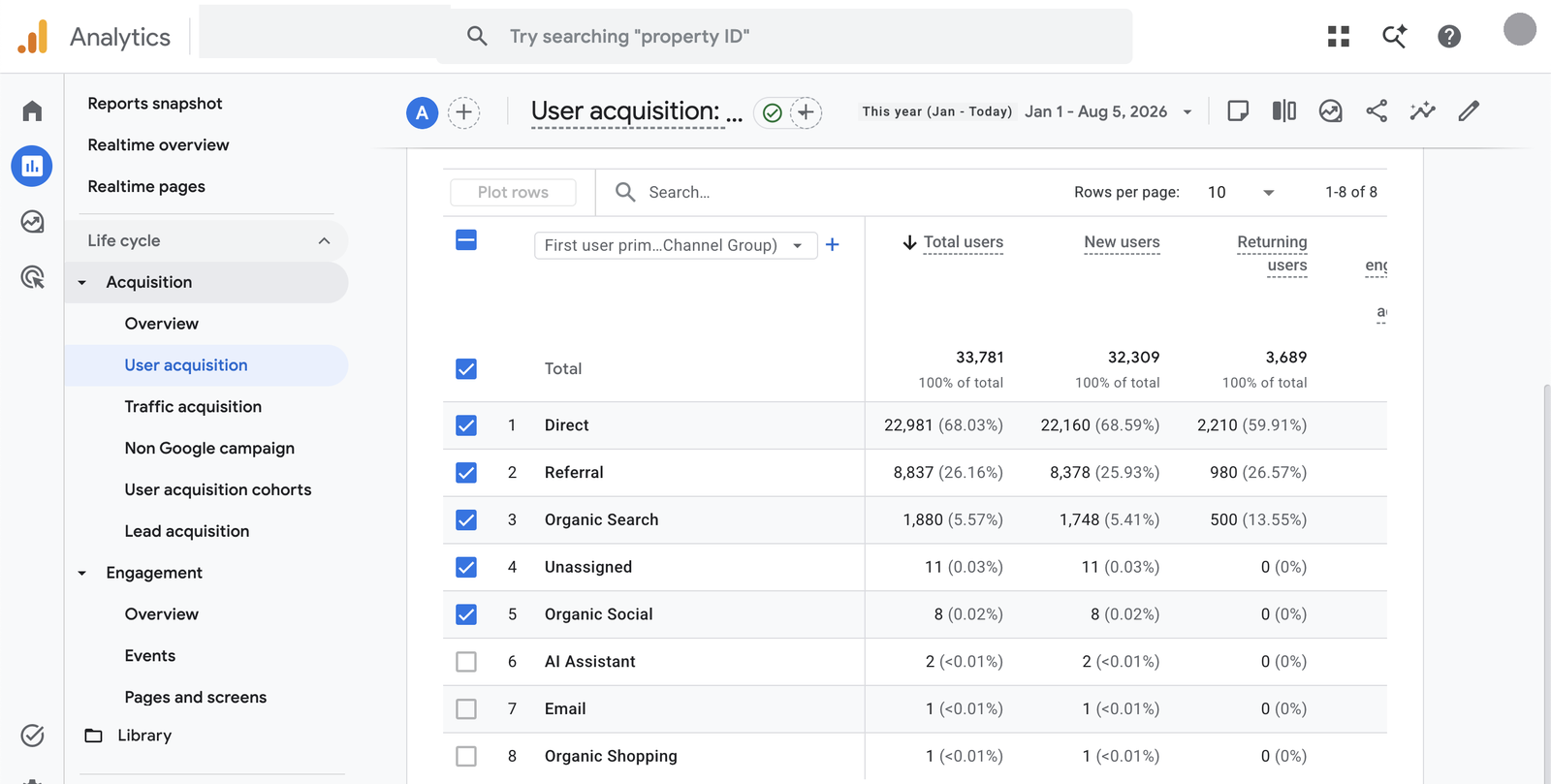
| GA4 traffic acquisition | Free | Google added a native "AI Assistant" channel to the Default Channel Group in May 2026, rolled out broadly by that June. It auto classifies sessions from ChatGPT, Gemini, Claude and Perplexity referrers with no setup required | Only counts clicks, most AI mentions never produce one, and it is not retroactive, so traffic from before the rollout stays under its old channel |
| Ahrefs Webmaster Tools | Free for verified sites | Backlinks and site audit for a domain you own | Your own verified property only |
| Semrush free account | Free, capped daily | A small number of keyword and domain lookups per day, enough to sanity check a shortlist | Roughly 10 requests a day on the free tier |
| Google Keyword Planner | Free with an Ads account | Search volume ranges for the questions you want to be the answer to | Shows banded ranges rather than exact volumes unless you are spending |
| Bing Webmaster Tools | Free | Bing index status, which sits underneath Copilot | Bing only |
| AI Crawler Check | Free | Whether your robots.txt is blocking any of the crawlers in the table above | Checks access, not citation |
Free tier details accurate as of August 4, 2026 and subject to change by each vendor. No affiliate links, no paid placements, on this page or anywhere on this site.
Run that for an hour and you will know more about your actual AI visibility than most paid dashboards will tell you in a month, because you will have seen the raw answers rather than a score derived from them. The paid tools earn their money later, on tracking change over time across hundreds of prompts. They are a monitoring purchase, not a diagnosis purchase.
Is GEO worth doing for your business
If your buyers research before they talk to sales, and most B2B buyers now do, yes, with one honest caveat: GEO is not a separate budget line you bolt onto existing SEO. It is a layer of specificity, evidence, and machine readable structure on top of content that already needs to be good for humans.
The businesses that treat it as a checkbox, adding an llms.txt file, sprinkling in some keywords, tend to see nothing change. Google says this directly in its own guidance, that you do not need special machine readable files or markup to appear in its AI features and that Search ignores them (Google Search Central). The businesses that treat it as "make our claims more specific and more provable" tend to see real movement, because specificity and provability are exactly what the underlying research measures.
Look at the table in the methods section again. Quotes, statistics, citations, clear prose. Every winning method describes content that is better sourced than its competition. That is a standard, not a trick, and most content does not meet it.
Where to go next
This page answers what GEO is and what the evidence for it actually says. For the tactical playbook, what to do about it, backed by a second and much larger controlled study plus an original 30 prompt test across five AI engines, read how to increase your AI visibility. If you want to check your crawler access first, the AI Crawler Check is free and takes a minute. If you would rather see this standard applied to your own site, that is what the audit checks.
What is generative engine optimization in simple terms?
Is GEO the same as SEO?
What is the difference between GEO and AEO?
Where did the term generative engine optimization come from?
Which GEO tactic worked best in the original study?
Does keyword stuffing help with AI search?
Does blocking Google-Extended remove me from AI Overviews?
Does ranking well in Google guarantee an AI citation?
Do I need a paid tool to do GEO?
Primary sources: Aggarwal et al., GEO: Generative Engine Optimization, ACM SIGKDD 2024 (arXiv:2311.09735), Tables 2 and 3 · Google Search Central, Guide to optimizing for generative AI features and Google crawlers documentation · Ahrefs AI Overview citation analysis, via Search Engine Journal, March 2026. All accessed August 4, 2026.